













Uluslararası Suçlar ve Tarih / International Crimes and History
| Number | : | 27 |
|---|---|---|
| Year | : | 2026 |
| Price | : | 60.00 TL |
Download PDF
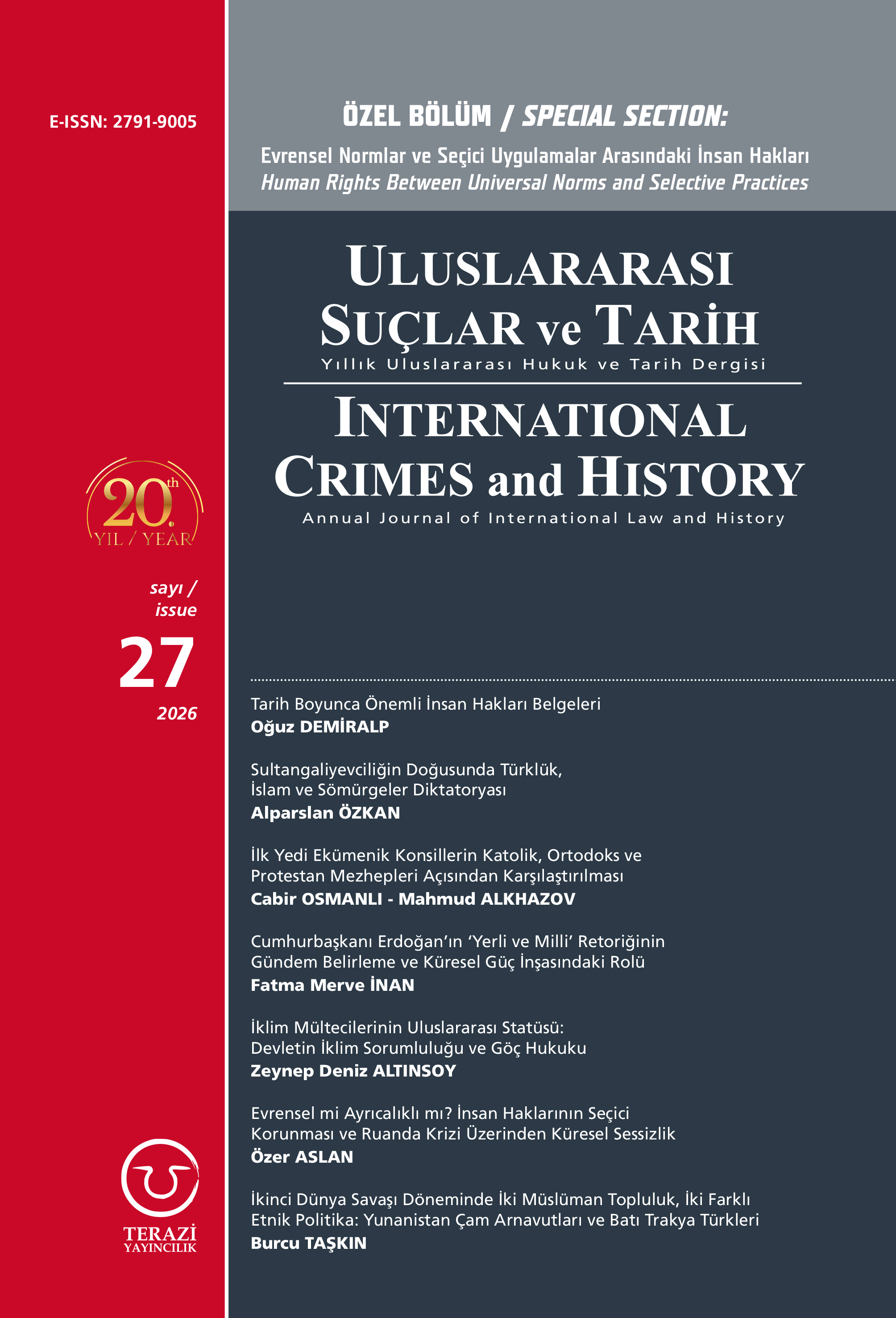
This 27th issue, marking the 20th publication year of Uluslararası Suçlar ve Tarih / International Crimes and History (UST/ICH), appears at a moment when the global order is once again being tested by protracted conflicts, widening humanitarian emergencies, and mounting contestation over the universality and enforcement of human rights norms. Armed confrontations in Ukraine, Gaza, Sudan, Myanmar and across the Sahel continue to erode longstanding constraints on the conduct of war, while the number of interstate conflicts and related casualties has reached levels not seen since the mid1990s. In this deteriorating environment, debates over accountability, selectivity and double standards in the application of international law have intensified and have become central to global political legitimacy. Türkiye, situated at the intersection of these regional crises, faces its own dense agenda of foreign policy tests, forced migration pressures and societal polarization, and therefore stands at the forefront of discussions on how law, politics and history intersect in addressing international crimes and largescale human rights violations.
In such a context, it is neither accidental nor merely commemorative that our 20th year coincides with a special issue in which human rights, both as a historical normative project and as a contested field of contemporary practice, forms the unifying theme. This issue’s focus, which we may characterize as “Human Rights Between Universal Norms and Selective Practices,” brings together contributions that examine the longue durée evolution of rights, the ways in which states and movements in different regions have mobilized or resisted these norms, and the enduring tension between universalist claims and particularistic power struggles. By tracing human rights from theirearly textual formulations to presentday crises of implementation, and by situating them in specific historical, ideological and geopolitical settings, the contributions expand our journal’s thematic reach in line with contemporary challenges, while extending our gaze to new fault lines of the 21stcentury order.
We also take note of the growing islamophobia which is increasingly evolving into anti-islamism. The commentary that opens this issue, Ambassador (Ret.) Oğuz Demiralp’s “Major Human Rights Documents Throughout History,” offers a panoramic overview of the development of human rightsfrom early legal codes to the post1945 United Nations framework. By following a rajectory from ancient texts and early constitutional limitations through the American and French declarations and into contemporary human rights instruments, the article highlights both the intellectual diversity of the rights tradition and the enduring gap between normative ambition and practical enforcement. It thus provides a conceptual frame for the articles that follow.
The special section, “Human Rights, Empire and the Politics of Exclusion,” begins with Alparslan Özkan’s study of Mirsaid SultanGaliev’s thought on Turkishness, Islam and socialism. Reexamining SultanGaliev’s call for a revolution originating in the “Oppressed East,” Özkan situates early 20thcentury antiimperialist debates in relation to contemporary discussions of structural inequality and global justice. Burcu Taşkın’s article on Cham Albanians and Western Thrace Turks in Greece then explores how two Muslim communities, marked by different historical trajectories and kinstate relations, experienced sharply divergent ethnic policies during and after the Second World War. By foregrounding questions of organization, treaties and security perceptions, the article sheds light on the selectivity of minority protection and the longterm implications of wartime violence.
The next set of contributions approaches the theme of authority and legitimacy from doctrinal and politicalcommunication perspectives. Cabir Osmanlı and Mahmud Alkhazov’s article compares the first seven ecumenical councils across Catholic, Orthodox and Protestant traditions, showing how diverging interpretations of these foundational gatherings contributed to schisms, institutional consolidation and competing claims to universality within Christianity. Fatma Merve İnan’s study of President Erdoğan’s “domestic and national” defenseindustry discourse analyzes how references to emblematic projects in the security and technology fields operate as instruments of agendasetting and framing. The article demonstrates how such discourse intertwines national pride, security narratives and aspirations to regional and global influence. The final articles turn explicitly to the tensions between universal human rights claims and selective practices. Özer Aslan’s examination of the 1994 Rwandan genocide highlights the disjunction between the proclaimed universality of human rights and the stark limits of international intervention, emphasizing how timing, political interests and postconflict narratives shape responses to mass atrocities. Zeynep Deniz Altınsoy’s contribution on the international status of climate refugees addresses one of the most pressing emerging challenges: the forced displacement produced by climate change in the absence of an adequate legal category or protection regime. By linking environmental harm, state responsibility and migration law, the article calls for new normative frameworks that would bring climateinduced displacement into the heart of human rights and international responsibility debates.
As we celebrate the 20th year of UST/ICH, it is appropriate to recall the founding vision articulated by Ambassador Gündüz Aktan in the very first editorial of the journal. Defining our scope around historical massacres and atrocities as well as the international crimes codified in the Rome Statute, he underlined the need to examine how law, politics and historical memory intersect in the face of mass violence. Two decades later, this issue’s focus on the history and practice of human rights – and on the distance between universalist norms and selective enforcement – can be read as a continuation and broadening of that original agenda. The questions raised in that first editorial remain strikingly relevant in a world still struggling with impunity, denial and instrumentalized justice.
This anniversary would not have been possible without the dedication of those who have guided the journal since its inception. We wish to express our deep gratitude to our previous managing and chief editors, to all members of the editorial and advisory boards, and to the colleagues who have contributed to the journal’s institutional consolidation over the years. Their efforts have ensured that UST/ICH could develop a distinct scholarly profile and sustain a high standard of academic rigor.
We also extend our sincere thanks to our authors, reviewers, readers and institutional partners, whose continued support has nourished the journal’s intellectual life over these twenty years. As we look ahead, our aim is to maintain UST/ICH as a platform where historically informed and legally grounded research on international crimes, human Rights and conflict can inform both academic debate and policy discussions. We hope that the analyses presented in this special issue will contribute to a clearer understanding of the relationship between universal norms and selective practices, and will inspire further work toward a more just and peaceful international order.