Download PDF :

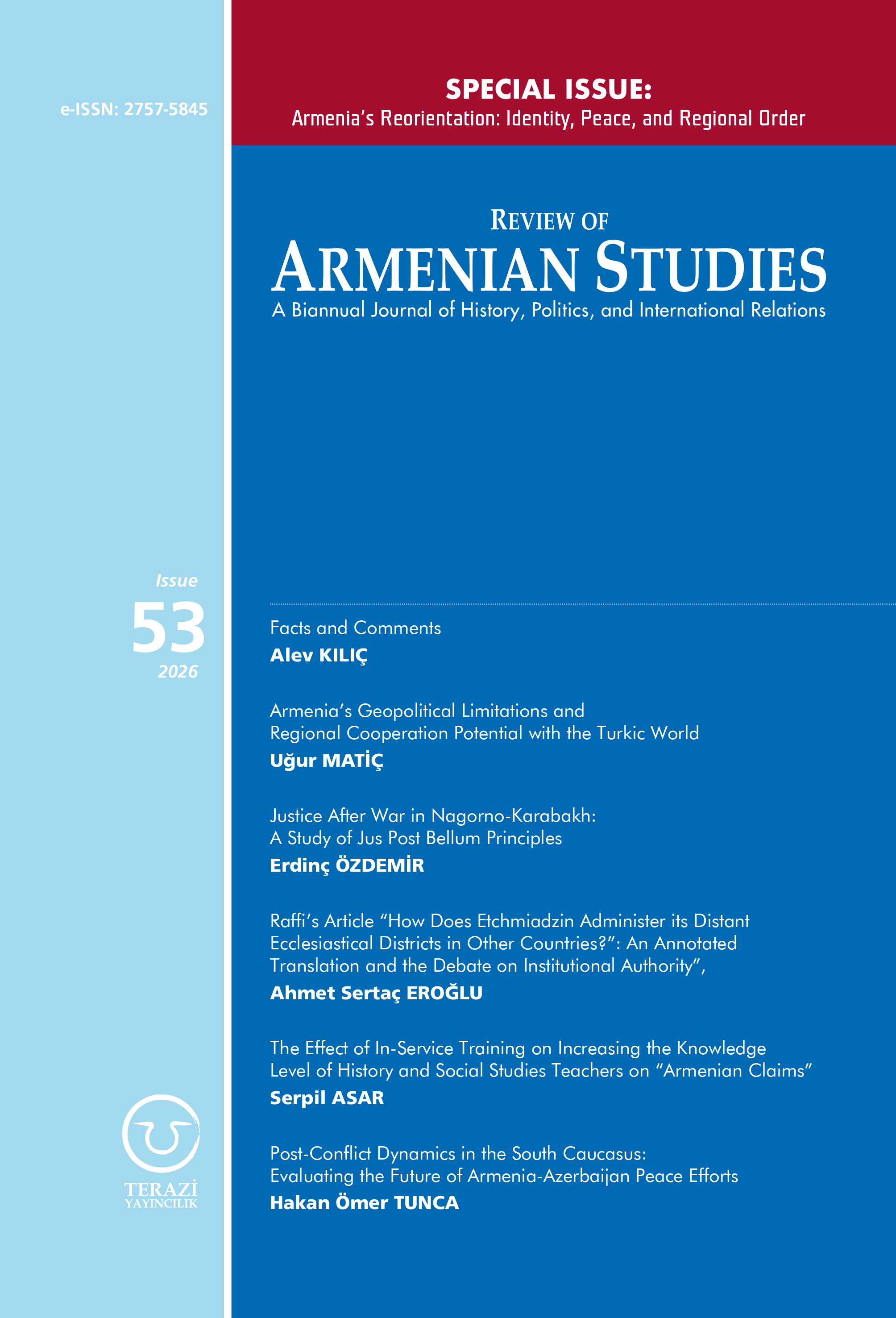
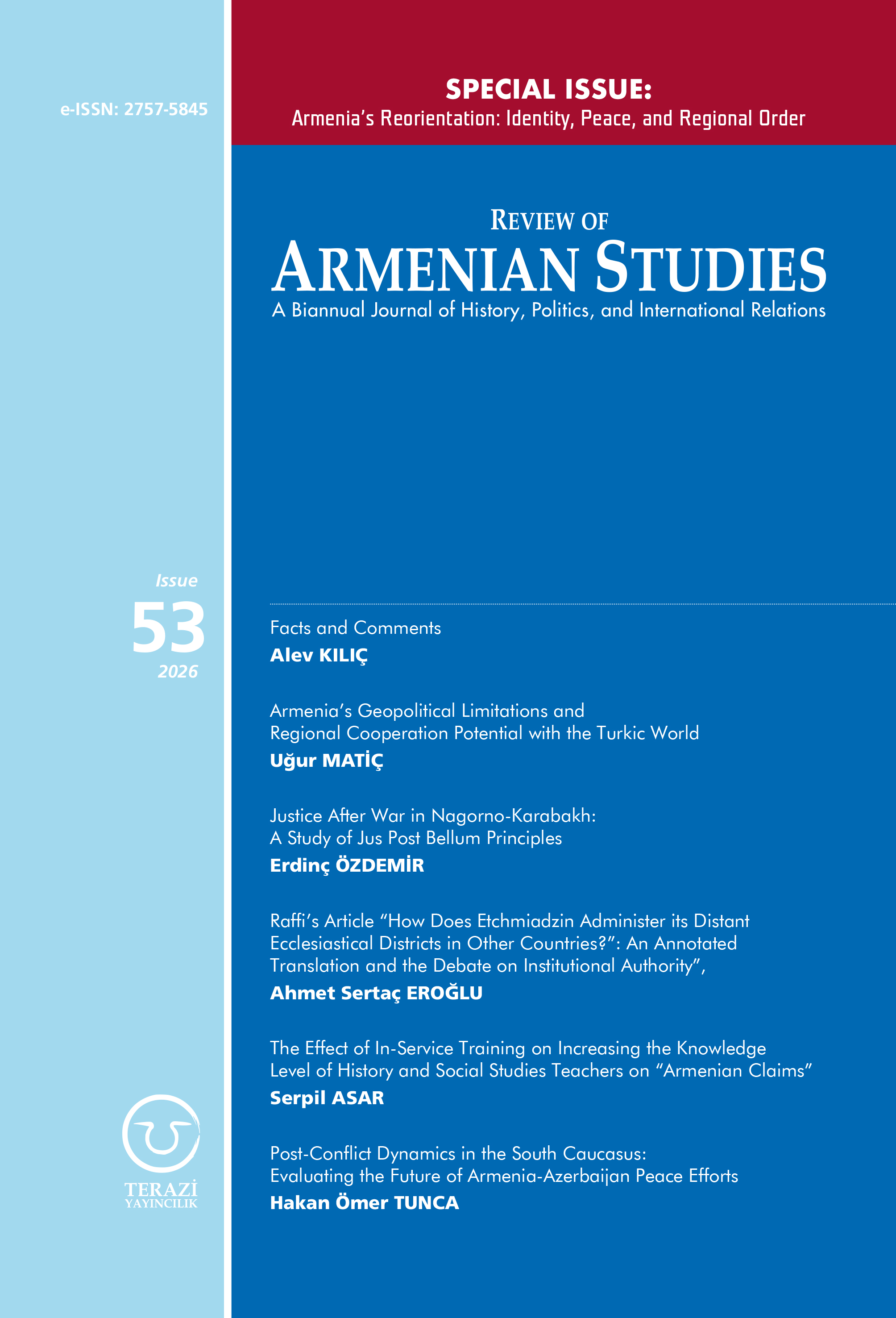
We are pleased to announce the publication of the 53rd issue of the Review of Armenian Studies (RAS), an edition that continues our commitment to rigorous, evidence-based scholarship on the historical and contemporary dimensions of the Armenian question and the evolving geopolitical landscape of the South Caucasus.
This issue is published at a moment of exceptional historical significance for the region. The Facts and Comments section surveys the period of December 2025–May 2026, documenting a series of landmark developments that have reshaped regional politics, including the first-ever EU–Armenia Summit in Yerevan, the 8th European Political Community Summit, Armenia's parliamentary elections, and the continuing progress toward a comprehensive Armenia–Azerbaijan peace agreement. These developments unfold alongside the gradual advancement of the Türkiye–Armenia normalization process, providing the broader context for this multidisciplinary volume.
The centerpiece of this issue is the special section, "Armenia's Reorientation: Identity, Peace, and Regional Order," which examines the profound transformation currently taking place within Armenia's domestic politics, foreign policy, and national identity. The contributions explore how peacebuilding, geopolitical realignment, historical narratives, and institutional change intersect during this pivotal period of regional transition.
Within this special section, Uğur Matiç analyzes Armenia's identity construction and its historical "othering" of Türkiye, arguing that the current normalization process presents an opportunity for Armenia to redefine its regional role and strengthen cooperation with the Turkic world.
Erdinç Özdemir applies the principles of jus post bellum to the Nagorno-Karabakh conflict, demonstrating that sustainable peace requires not only the cessation of hostilities but also the establishment of comprehensive legal, ethical, and institutional frameworks for post-conflict justice.
Hakan Ömer Tunca examines the transformation of diplomatic discourse surrounding the Armenia–Azerbaijan peace process through a systematic analysis of international documents, revealing a notable shift from security-centered narratives toward themes of regional connectivity, infrastructure, and long-term cooperation.
Providing a valuable historical perspective, Ahmet Sertaç Eroğlu presents an annotated translation of Raffi's influential nineteenth-century article on the governance of Etchmiadzin, highlighting the enduring relationship between ecclesiastical authority, nationalism, and Armenian political development.
Complementing the special section, Serpil Asar offers an empirical study evaluating the impact of in-service training on Turkish history and social studies teachers' knowledge of Armenian claims, contributing an important educational dimension to contemporary discussions surrounding historical narratives and public understanding.
As the South Caucasus undergoes one of its most consequential periods of transformation since the end of the Cold War, the 53rd issue of Review of Armenian Studies reaffirms its commitment to multidisciplinary scholarship, balanced analysis, and archival depth. By bringing together perspectives from international relations, law, political science, history, diplomacy, and education, this volume contributes to a deeper understanding of the evolving dynamics shaping regional peace, identity, and cooperation.
We extend our sincere gratitude to all authors, reviewers, and readers whose continued support sustains the journal's scholarly mission. For electronic access to the 53rd issue and previous volumes, please visit our website. For printed copies or inquiries, contact us at [email protected] or call +90 312 438 50 23.
Press the link and join us as we continue to explore the historical, political, and legal dimensions of the Armenian question and the evolving realities of the South Caucasus.