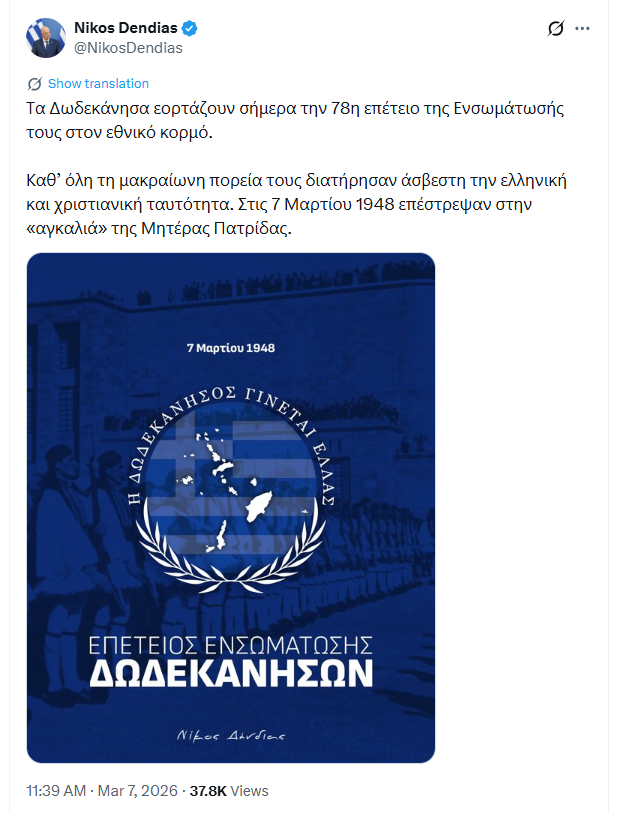
With his recent statements and provocative actions, Greek Defense Minister Nikos Dendias is essentially pursuing a policy that will add fuel to the fire in the Aegean region, which is already going through a very turbulent period and where a war is raging right next door. In addition to the deployment of Patriot missiles to the island of Karpathos, one of the Dodecanese islands with demilitarized status, and the alleged ongoing militarization reports on the island of Lemnos, also with demilitarized status, Dendias recently posted a statement on his X account regarding the Dodecanese islands stated: “Today the Dodecanese celebrate the 78th anniversary of their integration into the national structure. Throughout their centuries-long journey, they preserved their Greek and Christian identities. On March 7, 1948, they returned to the ‘embrace’ of the Homeland.”[1]
Recent Greek press reports also contain his similar statements like the one in which he stated that: “Greece is clearly committed to democratic Europe and its approach to the region is twofold: the security of the predominantly Orthodox Christian population and developing and maintaining friendly relations with Israel, Egypt, the United Arab Emirates, Saudi Arabia, other Gulf countries, and India., Turkey, on the other hand, has chosen another approach centered on Islam.”[2]
In our assessments, analyses, and comments on the demilitarized status of the Aegean Islands, AVİM has always addressed the current situation in detail within the framework of international law and legally binding international instruments, and has sought to explain the developments in this regard with courtesy and subtlety. In our writings on this subject, when referring to documents, we have always tried to exhibit as meticulous an academic approach as possible. However, Dendias's recent statements once again reveal that he is acting with a kind of "crusader mentality” against Türkiye, as always. On this occasion, it is necessary to briefly recall the international records on the territorial and sovereignty status of the Dodecanese Islands, to which Dendias refers as Greece's homeland.
In fact, Greece's official legal existence was established by the London Protocol of February 3, 1830, signed by Russia, England, and France. This was notified to the Ottoman Empire by the representatives of the three states on April 8, 1830. The Ottoman Empire, through its note dated 24 April 1830, communicated its recognition of Greece's establishment to the countries that founded it. In this new international environment, except for certain island groups, Crete and the eastern Aegean islands remained under Ottoman sovereignty. During the Italo-Turkish War of 1911-12, Italy occupied the southeastern Aegean islands known as the Dodecanese. Although Italy later agreed to relinquish these islands in exchange for Tripoli and Benghazi, in the Treaty of Ouchy of October 18, 1912, it continued to hold them during the Balkan Wars. On December 16, 1912, a conference was held in London, attended by the Ottoman Empire and the Balkan states. At the end of this conference, the Treaty of London was signed on May 30, 1913. It stipulated that a group of six states, which were briefly considered the "great powers" of the time, would determine the future of certain Aegean islands. Subsequently, provisions of the 1913 London Treaty, including those concerning the Aegean Islands, were accepted in the Athens Treaty signed on November 14, 1913, by the Ottoman Empire and Greece. In February 1914, the six states mentioned above, meeting in London, did not decide on the Dodecanese Islands. These developments were generally reiterated in a legally binding manner in the Lausanne Peace Treaty of July 24, 1923. After so many years, Türkiye relinquished all its rights to the Dodecanese Islands in favour of Italy under Article 15 of the 1923 Lausanne Treaty. These islands were subsequently ceded to Greek sovereignty under the condition of demilitarization in the Paris Peace Treaty signed between Italy and the victors of the Second World War on February 10, 1947, as a result of the changing political and military conditions following the Second World War. Türkiye was not a party to this treaty. In fact, in the Paris Treaty, while the spoils were divided among the winners, these islands were given to Greece.
Türkiye has always respected the rules stipulated by international law and international treaties. The Republic of Türkiye has consistently and persistently reminded Greece of the Aegean islands' non-military/demilitarized status and has officially recorded its opposition to their illegitimate behavior. It has officially stated that the gradual erosion and destruction of this status constitute a threat to its national security and formally communicated this in writing to the United Nations. It has adhered to the established international rules. In response, it has faced a "bullying" attitude, exemplified by the Greek Defense Minister Dendias, who seems to be embarking on a "crusade." This rhetoric and behavior must be abandoned. It is difficult to predict where pouring fuel on the fire will lead us. Those who disregard advice and warnings should be warned again, and those who ignore even repeated polite warnings should be prepared for unexpected and severe consequences.
Furthermore, those who occupy positions of responsibility should exercise the utmost care and attention to their words and actions, especially in times of global turbulence and tension.
*Picture: X
© 2009-2025 Center for Eurasian Studies (AVİM) All Rights Reserved
















 GUARDIANSHIP UNDER PRESSURE: DRONE ESCALATION, RUSSIAN MILITARIZATION, AND TÜRKIYE’S LEGAL ORDER IN THE BLACK SEA
 ROMANIA, THE BLACK SEA, AND THE LIMITS OF STRATEGIC SUBSTITUTION
 URGENT NEED TO STRENGTHEN THE EFFECTIVE IMPLEMENTATION OF THE BIOLOGICAL WEAPONS CONVENTION
 TÜRKİYE-SERBIA RAPPROCHEMENT AND THE BALKAN PEACE PLATFORM: TESTING BALANCING ROLE
 TÜRKİYE'S EVOLVING ROLE AS A EURASIAN NEXUS: A BALANCED PERSPECTIVE
 EUROPE AND THE EUROPEAN UNION - THE EUROPEAN SEGREGATION
 THE EUROPEAN PARLIAMENT AND ITS RESOLUTION ON THE 2015 PROGRESS REPORT ON TURKEY
 AN APPEAL OF THE ARMENIAN AND AZERBAIJANI CIVIL SOCIETY ACTIVISTS TO THE PRESIDENTS OF ARMENIA AND AZERBAIJAN
 THE DRAFT RESOLUTION APPROVED BY THE POLITICAL AFFAIRS COMMITTEE OF PACE