














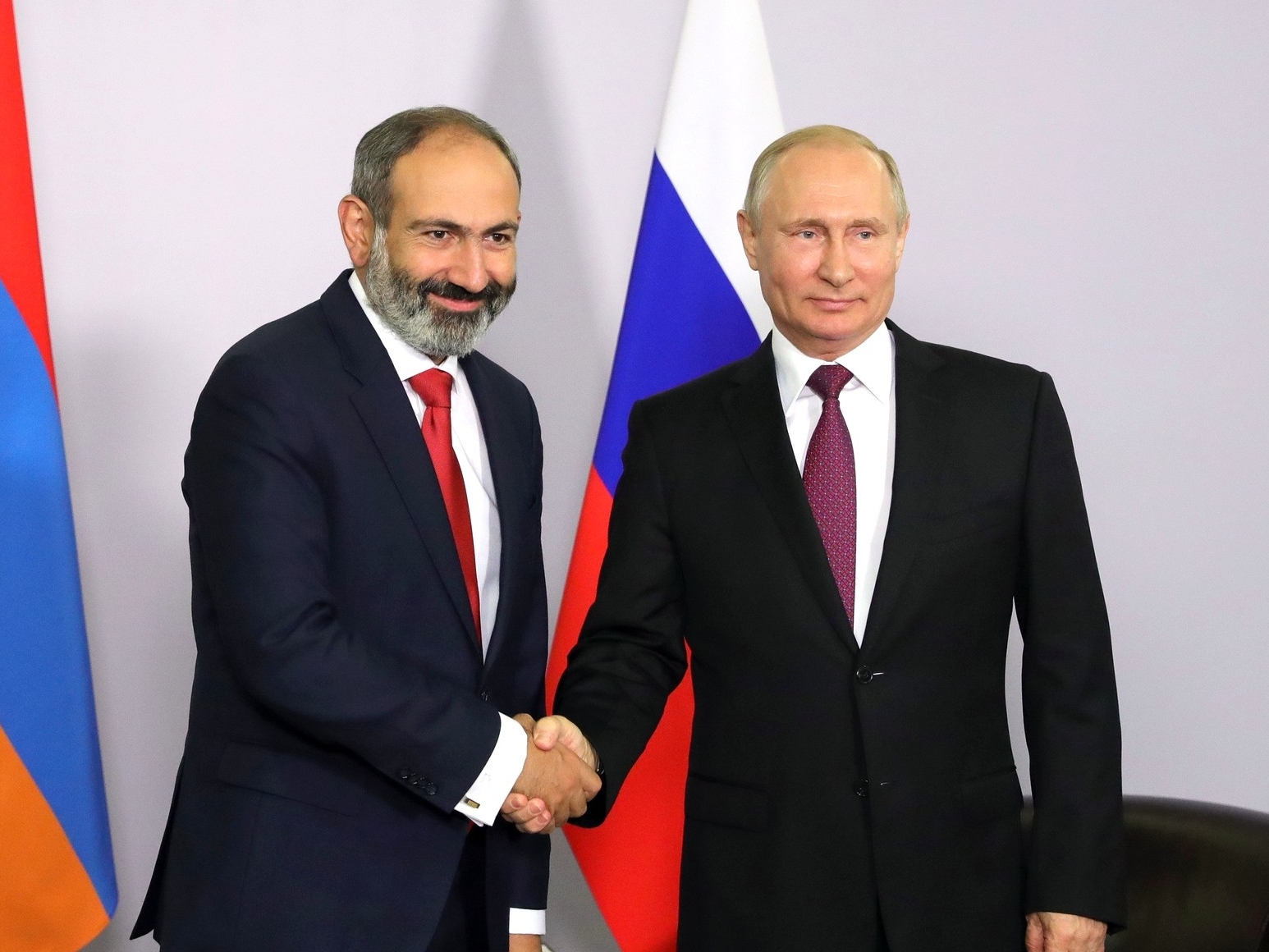
On 24 January 2025, Armenian Prime Minister Nikol Pashinyan stated, about the tragedy of 1915-1916: “We need to understand what happened, why it happened, and through whom we perceived the events.” On 31 October of the same year, he was even more explicit: “‘When we say, ‘A Turk never changes,’ they say the same about Armenians. When we say, “How can we trust Azerbaijan?,’ they say the same about Armenians. ‘We must free ourselves from the worldview that was shaped for us by KGB agents.”[1] Regrettably, these crucial declarations were not sufficiently commented in Western Europe, in North America or even in Türkiye. They should not be considered only as another symptom of the tensions between Yerevan and Moscow. They are in fact accurate. Some too little known elements would be useful in this regard.
In 1928-1929, in the context of the radicalization of his regime, internally[2] and externally, USSR leader Joseph Stalin provoked a crisis with Türkiye and Kemalism was suddenly compared to Fascism in the Soviet press.[3] At the same time, the USSR funded, through the International Minority Movement in Odessa, the coalition of the Armenian Revolutionary Federation, of the Hoybun (Kurdish nationalist group, ancestor of the PKK) and of the Turkish Monarchist Committee. One of the main men connecting the three groups was Mevlanzade Rifat, a pioneer of Kurdish nationalism, closely linked to the ARF, who published an entirely misleading book in Aleppo (he described himself as a former leader of the Committee Union and Progress, but never was so, actually),[4] used until today to support the “Armenian genocide” claims.[5] Regardless, due to the isolation of the USSR at that time, to the defeat of the Hoybun in 1930 and to the strategic location of Türkiye, the crisis was short-lived.
The USSR re-activated the Armenian issue in 1939,[6] just after the signing of the alliance with Nazi Germany,[7] then in 1945-1948, in both cases in order to justify its territorial claims on Kars and Ardahan, as well as for military facilities on the Bosporus,[8] but the genocide allegation as such was of course not used in 1939, as the word was not yet coined, and rarely in 1945-1948.[9]
The situation started changing during the 1950s. Armenian nationalism had been silenced in 1948, as a result of the failure of the territorial claims against Türkiye, but started being rehabilitated in 1954, after the death of Stalin.[10] In 1957, the USSR proposed to the ARF, which had been almost constantly anti-Soviet since 1920s (with a brief and partial interruption in 1928-1929), to leave the American alliance and to enter the Soviet one. A support of Moscow for an international “recognition” of the “Armenian genocide” claims was offered to secure the deal. Initially, the ARF leadership did not accept, but by 1963, supporters of the Soviet alliance (Hrair Maroukian and Papken Papazian) begin to be elected at the world bureau of the party, and, after 1965, the ARF actually changed its alliance[11] and Maroukian was the main world leader of the ARF from 1971 to 1994. After 1972, the ARF of Lebanon broke up with the (staunchly anti-Communist) Kataeb Party and even excluded its local leaders who were the most involved in the alliance.[12]
Coincidences of dates are remarkable. In 1963, too, the first Soviet book supporting the “Armenian genocide” claims was published, then it was translated into English and published in January 1965, becoming the very first book in a Western language presenting this accusation.[13] And also in 1963, David Marshall Lang (1924-1991), a former British diplomat who became a scholar, specialist of Georgia, was recruited by the KGB on the basis of compromising elements (kompromat). As late as 1962, Lang had described mercilessly the incompetence of the Armenian nationalist leadership at the Paris Conference of 1919 and the Stalinist terror in Georgia.[14] Then, suddenly, after 1965, he became the main responsible for the diffusion of the “Armenian genocide” claims in UK—a country where the Armenian community is not only small, and had been dominated from 1930s to 1950s by Calouste Gulbenkian (1869-1955), an uncompromising adversary of Armenian nationalism.
Lang was not the only scholar of this kind. Until mid-1950s, Vahakn Dadrian, an American sociologist born in Istanbul, was linked to the US government. In late 1950s, he turned to the Soviet side and visited Moscow. In returned there again in 1960, “but on that occasion he was expelled for rape.”[15] In other words, the KGB decided to spare him several years in jail or in the gulag. It is obvious that his favour was not given for free. Yet, Dadrian was active against the Turks from 1964 to late 2000s—with an inordinate capacity to distort authentic sources and to shameless use crude fakes[16]—, and he was also the author of the first pro-Soviet article ever published in the ARF journal of in the US, The Armenian Review, in 1966.[17]
*Picture: Eurasianet
[1] “Pashinyan blames Soviet KGB for shaping Armenians’ view of Turks and Azerbaijanis,” OC Media, 3 November 2025.
[2] Robert Conquest, The Harvest of Sorrow, New York-Oxford: Oxford University Press, 1986, pp. 87-163.
[3] Walter Laqueur, The Soviet Union and the Middle East, New York: Praeger, 1959, pp. 105-106.
[4] Gwynne Dyer, “Correspondence,” Middle Eastern Studies, Vol. 9, No. 3, October 1973, pp. 379-382.
[5] For samples of this use, in spite of Dr. Dyer’s response: R. Hrair Dekmejian, “Determinants of Genocide: Armenians and Jews as Case Studies,” in Richard G. Hovannisian (ed.), The Armenian Genocide in Perspective, New Brunswick-London: Transaction Publishers, 2007, p. 96, n. 6; Fatma Müge Gökçek, Denial of Violence, New York-Oxford: Oxford University Press, 2014, pp. 580, 586 and 591.
[6] Telegram of René Massigli, ambassador of France in Ankara, to the Ministry of Foreign Affairs, 20 October 1939; Response of the MFA to Massigli, 27 October 1939, Centre des archives diplomatiques de Nantes, 36PO/1/111; « L’évolution de la situation diplomatique », L’Ouest-Éclair, 28 October 1939, p. 3; « Turquie et URSS », Le Populaire, 15 December 1939, p. 3.
[7] Roger Moorhouse, The Devils’ Alliance: Hitler’s Pact with Stalin, 1939-1941, New York: Basic Books, 2014.
[8] Mustafa Sıtkı Bilgin, “Soviet-Armenian Collaboration against Turkey during the post-second World War Period, Review of Armenian Studies,” Review of Armenian Studies, Vol. 2, No. 5, 2003, pp. 20-36.
[9] The word is absent in most of books and booklets published at that time, for instance James Mandalian, What do the Armenians Want?, [New York or Boston], Armenian National Committee, 1946 and Charles Aznakian Vertanes, Armenia Reborn, New York: The Armenian National Council of America, 1947.
[10] Mary Kilbourne Matossian, The Impact of the Soviet Policies in Armenia, Leyden: E. J. Brill, 1962, pp. 199-202.
[11] Gaïdz Minassian, Guerre et terrorisme arméniens, Paris : Presses universitaires de France, 2002, pp. 18-20.
[12] Ibid., pp. 23 and 46.
[13] Ervand K. Sarkisian and Ruben G. Sahakian, Vital Issues in Modern Armenian History, Watertown (Massachusetts): Armenian Studies, 1965.
[14] David Marshall Lang, A Modern History of Georgia, London: Weidenfeld and Nicolson, 1962, pp. 219-220 and 245-274. The book was published in a series edited at that time by Bernard Lewis.
[15] Dispatch of the CIA (Munich) on Vahakn Dadrian, 30 July 1962.
[16] Guenter Lewy, The Armenian Massacres in Ottoman Turkey, Salt Lake City: University of Utah Press, 2005, pp. 43-128.
[17] Vahakn Dadrian, “The Development of the Soviet Posture on Nationalities,” The Armenian Review, XIX/3-75, Autumn 1966, pp. 32-47.
© 2009-2025 Center for Eurasian Studies (AVİM) All Rights Reserved
No comments yet.
-
 WHAT KIND OF “RECONCILIATION” IS THE HRANT-DINK FOUNDATION PROMOTING?
Maxime GAUIN 19.03.2015 -
 THE TURKISH-ARMENIAN DISPUTE: WHO HAS SOMETHING TO HIDE?
Maxime GAUIN 13.10.2014 -
 WHO IS RESPONSIBLE FOR THE CLOSING OF TURKISH-ARMENIAN BORDER?
Maxime GAUIN 04.02.2015 -
 THE NEW REVENGE OF LAW ON POLITICS
Maxime GAUIN 25.10.2015 -
 THIRD LEGAL VICTORY AGAINST ARMENIAN NATIONALISTS IN FRANCE
Maxime GAUIN 05.05.2014
-
 REACTIONS TOWARD ERDOĞAN’S MESSAGE
Ömer Engin LÜTEM 28.04.2014 -
 DELEGATION of AVIM VISITED the ECO SECRETARIAT
AVİM 17.09.2015 -
 A NEW TENSION EMERGING IN THE SOUTH CAUCASUS CONCERNING THE ISSUE OF RELIGIOUS REPRESENTATION
İlaha KHANTAMİROVA 31.07.2025 -
 WILL MORE CASES BE ADDED ON TO THE LIST OF SENATOR MENENDEZ’S CORRUPTION SCANDALS, WHICH HAVE COME TO LIGHT AT REGULAR INTERVALS?
Hazel ÇAĞAN ELBİR 10.01.2024 -
 THE POLITICAL DEADLOCK IN GEORGIA HAS COME TO AN END
Ceyda ACİCBE 06.05.2021
-
25.01.2016
THE ARMENIAN QUESTION - BASIC KNOWLEDGE AND DOCUMENTATION -
12.06.2024
THE TRUTH WILL OUT -
27.03.2023
RADİKAL ERMENİ UNSURLARCA GERÇEKLEŞTİRİLEN MEZALİMLER VE VANDALİZM -
17.03.2023
PATRIOTISM PERVERTED -
23.02.2023
MEN ARE LIKE THAT -
03.02.2023
BAKÜ-TİFLİS-CEYHAN BORU HATTININ YAŞANAN TARİHİ -
16.12.2022
INTERNATIONAL SCHOLARS ON THE EVENTS OF 1915 -
07.12.2022
FAKE PHOTOS AND THE ARMENIAN PROPAGANDA -
07.12.2022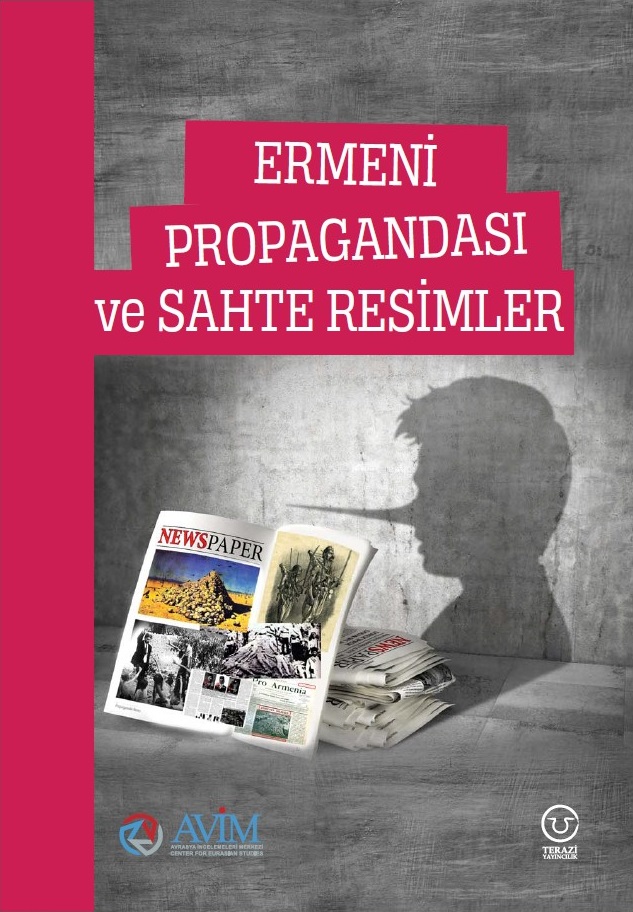
ERMENİ PROPAGANDASI VE SAHTE RESİMLER -
01.01.2022
A Letter From Japan - Strategically Mum: The Silence of the Armenians -
01.01.2022
Japonya'dan Bir Mektup - Stratejik Suskunluk: Ermenilerin Sessizliği -
03.06.2020
Anastas Mikoyan: Confessions of an Armenian Bolshevik -
08.04.2020
Sovyet Sonrası Ukrayna’da Devlet, Toplum ve Siyaset - Değişen Dinamikler, Dönüşen Kimlikler -
12.06.2018
Ermeni Sorunuyla İlgili İngiliz Belgeleri (1912-1923) - British Documents on Armenian Question (1912-1923) -
02.12.2016
Turkish-Russian Academics: A Historical Study on the Caucasus -
01.07.2016
Gürcistan'daki Müslüman Topluluklar: Azınlık Hakları, Kimlik, Siyaset -
10.03.2016
Armenian Diaspora: Diaspora, State and the Imagination of the Republic of Armenia -
24.01.2016
ERMENİ SORUNU - TEMEL BİLGİ VE BELGELER (2. BASKI)
-
AVİM Conference Hall 24.01.2023
CONFERENCE TITLED “HUNGARY’S PERSPECTIVES ON THE TURKIC WORLD"